
Honda Accord vs Toyota Camry Which Should You Choose
A decade-long rivalry settled — with a local expert’s perspective from Warsaw, Indiana.
The debate between the Honda Accord and Toyota Camry has been running for decades. Both vehicles have earned their places as top choices for American drivers — reliable, refined, and packed with value. But when it comes to Warsaw, Indiana drivers facing winter weather, highway commutes, and family road trips, one sedan consistently rises to the top.
At Toyota of Warsaw, we’ve helped neighbors choose between these two legendary midsize sedans for years. We’ve seen firsthand how both perform in real-world Indiana conditions. This guide gives you everything you need: performance specs, fuel economy, interior space, safety features, pricing, and a straight answer about which sedan delivers better long-term value for your life.
The Bottom Line Up Front
The 2025 Toyota Camry is now exclusively hybrid across all trims — meaning you get outstanding fuel efficiency, available AWD, and Toyota Safety Sense standard, regardless of which trim you choose. The Honda Accord keeps traditional engines on base trims and offers no AWD option. For Indiana winters and long-term value, the Camry holds a clear edge.
Both sedans are excellent vehicles. The goal of this guide is to help you make the right choice for your specific needs — not just pick a winner. Let’s dive in.
Two Midsize Sedan Giants: An Overview
The Honda Accord and Toyota Camry have been rivals since the 1980s, consistently trading places as the best-selling midsize sedans in America. Both have earned their popularity through decades of continuous improvement, strong reliability records, and genuine customer satisfaction. Choosing between them isn’t about picking a good car over a bad one — it’s about matching the right strengths to your lifestyle.
The 2023 Accord brought a full redesign with fresh styling, updated technology, and refined handling. The 2025 Camry took a bolder step: Toyota eliminated non-hybrid powertrains entirely, making every Camry a hybrid. This signals where Toyota’s priorities lie — and for drivers who want efficiency built in from the start, it removes any guesswork from the buying process.
| Feature | Honda Accord | Toyota Camry |
|---|---|---|
| U.S. Market Presence | Since 1982 | Since 1983 |
| Latest Major Update | Full redesign 2023 | All-hybrid refresh 2025 |
| Powertrain Strategy | Gas and hybrid options | Hybrid-only lineup |
| AWD Availability | Not available | Available on multiple trims |
| Core Strength | Sporty handling & driver engagement | Reliability, comfort & all-weather capability |
Performance and Powertrain Options
Both sedans offer hybrid technology, but their approaches differ in important ways. Understanding those differences helps you pick the powertrain that matches your daily driving in Warsaw, Indiana.
Honda Accord Engine Lineup
The Accord gives you a choice. Base LX and Sport trims use a traditional 1.5-liter turbocharged gasoline engine. From Sport-L upward, Honda’s hybrid system takes over — pairing a 2.0-liter engine with two electric motors to produce 204 horsepower and 247 lb-ft of torque. The Accord Hybrid runs from 0–60 mph in 6.4 seconds and tops out at 125 mph. It’s a genuinely engaging drive with a sporty, connected feel through corners.
Toyota Camry Engine Choices
The 2025 Toyota Camry takes a simpler approach: every single model is a hybrid. No upgrades required, no trim-level decisions to worry about for efficiency — it’s built in from the base LE. The Camry’s 2.5-liter hybrid system produces 225 hp with FWD and 232 hp with AWD, where a third electric motor powers the rear axle. The 0–60 time of 6.8 seconds trails the Accord slightly, but the Camry’s AWD system is a meaningful advantage on Indiana’s winter roads that the Accord simply cannot match.
| Performance Metric | Honda Accord Hybrid | Toyota Camry Hybrid FWD | Toyota Camry Hybrid AWD |
|---|---|---|---|
| Horsepower | 204 hp | 225 hp | 232 hp |
| 0–60 mph | 6.4 seconds | 6.8 seconds | 6.8 seconds |
| Top Speed | 125 mph | 115 mph | 115 mph |
| Skidpad Grip | 0.85 g | 0.84 g | 0.84 g |
| AWD Option | Not Available | Not Available | Standard on trim |
Driving Dynamics and Ride Quality
The Accord is the sportier choice — tighter, more athletic, with steering that delivers genuine road feel and a chassis that communicates well through corners. If weekend driving enjoyment is high on your list, the Accord delivers more of it. The trade-off is ride firmness: you’ll feel more of Warsaw’s potholes and highway expansion joints in the Accord than in the Camry.
The Camry prioritizes comfort without sacrificing competence. Its suspension absorbs road imperfections quietly and effectively, making daily commutes less fatiguing. For Indiana highways — US-30, SR-15, and the run to Fort Wayne — the Camry’s composed, quiet ride makes every mile easier on the driver and passengers.
Fuel Economy and Real-World Efficiency
The difference in fuel efficiency between these two sedans can save you hundreds of dollars annually. Both use advanced hybrid technology, but how each manufacturer deploys it affects your wallet differently — especially on Indiana highway drives.
City and Highway MPG Ratings
The Toyota Camry AWD XSE earns an EPA-estimated 43 city / 44 highway / 44 combined MPG. The Honda Accord Hybrid matches that combined rating at 44 MPG — but achieves it differently: 46 city / 41 highway. For Warsaw drivers who regularly travel US-30 to Fort Wayne or Indianapolis, the Camry’s superior highway number means less money spent on long runs.
Real-World Testing and Range
At 75 mph — a realistic highway cruising speed — the Camry held 43 MPG, nearly matching its EPA rating. The Accord Hybrid dropped to 39 MPG under the same conditions, a larger gap between claimed and real-world performance. The practical result: the Camry delivers approximately 550 miles of highway range per tank, compared to roughly 490 miles for the Accord. That’s 60 fewer miles — meaning an extra fill-up on any Warsaw-to-Chicago roundtrip.
Hybrid Availability Across Trims
This is where the Camry has a structural advantage. Every 2025 Camry is a hybrid — from the base LE to the XSE AWD. You don’t choose a hybrid; you simply choose a Camry. The Accord requires buyers to step up to Sport-L or higher for hybrid benefits. Base LX and Sport trims use a traditional gasoline engine. Budget-conscious shoppers who want hybrid efficiency from the Accord must spend more upfront to get it.
| Efficiency Metric | Toyota Camry AWD XSE | Honda Accord Hybrid |
|---|---|---|
| EPA City MPG | 43 mpg | 46 mpg |
| EPA Highway MPG | 44 mpg | 41 mpg |
| EPA Combined MPG | 44 mpg | 44 mpg |
| Real-World 75 MPH Test | 43 mpg | 39 mpg |
| Highway Driving Range | ~550 miles | ~490 miles |
| Hybrid Available at Base Trim | Yes — all trims | No — Sport-L and above |
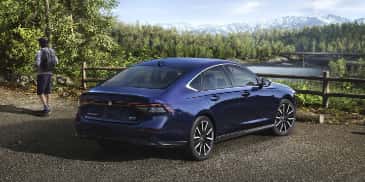
The Honda Accord brings a sporty, driver-focused feel — but the 2025 Toyota Camry counters with available AWD, standard hybrid efficiency, and superior long-trip comfort. Compare both at Toyota of Warsaw.
225–232 hp
Camry Hybrid system output — 225 hp FWD, 232 hp with available AWD for Indiana winter confidence.
44 MPG Combined
Camry AWD XSE combined fuel economy — 550-mile highway range and consistent real-world performance at 75 mph.
68% Resale Value
Expected 3-year value retention for the Camry — vs. 65% for the Accord, protecting more of your investment.
Interior Comfort, Space, and Materials
Open the doors of both sedans and you’re looking at two different interpretations of what a premium midsize interior should be. Both are well-executed — but they prioritize different things.
Design and Material Quality
The Camry’s flowing dashboard design makes an immediate impression, with contrast-color leather trim available and an optional panoramic glass roof that opens the cabin. Soft-touch surfaces and thoughtful material layering give the Camry a more upscale feel that customers consistently notice when comparing the two side by side. The Accord leans into minimalism — clean lines, honeycomb mesh textures, and excellent functional layout — but its materials feel a tier below the Camry’s in higher trims.
Passenger and Cargo Dimensions
The Accord is 2.2 inches longer overall and offers more rear passenger volume — 50 cubic feet versus the Camry’s 46. Taller rear passengers may appreciate that extra space on long trips. Trunk capacity also favors the Accord at 17 cubic feet versus 15 for the Camry. However, the Camry’s trunk earns practical points for its flat floor and wider opening, making it easier to load bulky items like strollers, coolers, and luggage.
| Dimension | Honda Accord | Toyota Camry |
|---|---|---|
| Overall Length | 195.7 inches | 193.5 inches |
| Overall Width | 73.3 inches | 72.4 inches |
| Front Passenger Volume | 53 cubic feet | 53 cubic feet |
| Rear Passenger Volume | 50 cubic feet | 46 cubic feet |
| Trunk Capacity | 17 cubic feet | 15 cu. ft. — flatter floor, wider opening |
Long-Distance Comfort
On road trips, the Camry’s seat design and cushioning pull ahead. Available heated and ventilated front seats, an available heated steering wheel, and a noticeably quieter cabin make multi-hour drives more comfortable for driver and passengers alike. The Accord’s seats are supportive and well-suited for daily commuting, but the Camry’s additional refinement is felt over longer distances. Visit our Camry overview page to explore trim-specific comfort features in detail.
Technology and Infotainment
Both sedans are well-equipped with modern technology. But daily usability — how fast things respond, how reliably your phone connects, how clear the backup camera is at night — reveals meaningful differences in real-world use.
Touchscreen and Connectivity
Both sedans offer 12.3-inch touchscreens on upper trims. The Camry’s system is notably more responsive — taps and swipes register immediately with no lag. The Accord’s system can be slow to respond, causing small but consistent frustrations in daily use. Wireless Apple CarPlay and Android Auto are standard on both, but the Camry pairs more quickly and reliably. The Accord’s wireless connection can take several minutes to establish — a minor annoyance that adds up over time. The Camry’s backup camera also performs better in low light, producing a clear image where the Accord’s can appear grainy.
Driver Assistance Technology
Both sedans include comprehensive standard safety suites. The Accord ships with Honda Sensing; the Camry with Toyota Safety Sense. Both cover automatic emergency braking, lane departure warnings, and adaptive cruise control. Where the Camry pulls ahead is in advanced features available on higher trims — traffic-jam assist, lane-change assist, and parking assist with automatic braking — features that aren’t offered on any Accord trim level.
| Technology Feature | Toyota Camry | Honda Accord |
|---|---|---|
| Touchscreen Size (Upper Trims) | 12.3-inch | 12.3-inch |
| Wireless CarPlay / Android Auto | Fast, reliable pairing | Slow pairing, occasional delays |
| Backup Camera in Low Light | Clear image | Grainy image |
| Standard Safety Suite | Toyota Safety Sense | Honda Sensing |
| Traffic-Jam Assist | Available on higher trims | Not available |
| Parking Assist w/ Auto Braking | Available on XLE and higher | Not available |
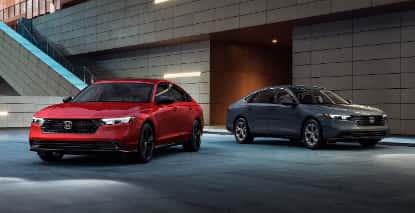
The Honda Accord’s minimalist interior is clean and functional — but the Toyota Camry’s premium materials, faster touchscreen, and available advanced safety features give it an edge for Warsaw families.
Safety Ratings and Advanced Safety Features
Keeping your family safe is the most important factor in any vehicle purchase. Both the Accord and Camry take safety seriously — but the Camry delivers more advanced features to more buyers without requiring top-trim pricing.
Crash Test Ratings
Both sedans earn five-star overall safety ratings from the National Highway Traffic Safety Administration — the highest possible score. Both also perform well in Insurance Institute for Highway Safety testing, including the difficult small-overlap front crash test. In pure crashworthiness, these sedans are peers.
Standard Safety Equipment
Toyota Safety Sense comes standard on all Camry trims and includes pre-collision warning with automatic emergency braking (detecting vehicles, pedestrians, and cyclists), lane departure alert with steering assist, full-speed range dynamic radar cruise control, and automatic high beams. Honda Sensing on the Accord is equally capable, covering collision mitigation braking, road departure mitigation, adaptive cruise control, and lane keeping assist. Both suites are comprehensive and effective.
Advanced Features by Trim Level
The Camry’s advantage is availability. Blind spot monitoring and rear cross-traffic alert are standard from the SE trim upward on the Camry. On the Accord, they’re limited to Sport and higher trims. Traffic-jam assist, parking assist with automatic braking, and lane-change assist are available on Camry XLE and XSE — none of these features are offered at any Accord trim level.
| Safety Feature | Honda Accord | Toyota Camry | Advantage |
|---|---|---|---|
| NHTSA Overall Rating | 5 Stars | 5 Stars | Tie |
| Standard Safety Suite | Honda Sensing — all trims | Toyota Safety Sense — all trims | Tie |
| Blind Spot Monitoring | Sport trim and higher | SE trim and higher | Camry |
| Traffic-Jam Assist | Not available | Available on higher trims | Camry |
| Parking Assist w/ Auto Braking | Not available | Available on XLE and higher | Camry |
Reliability and Long-Term Ownership
Both sedans have earned strong reliability reputations — but Toyota’s engineering philosophy and quality control processes give the Camry a consistent edge in long-term dependability data. For Warsaw drivers planning to keep their vehicle for 100,000 miles or more, that edge matters.
Long-Term Dependability
The Toyota Camry regularly tops J.D. Power reliability rankings for the midsize sedan segment. Camry owners at Toyota of Warsaw routinely drive past 200,000 miles with proper maintenance. The Honda Accord also earns strong reliability marks — above average for the segment — but Toyota’s manufacturing standards and parts quality give the Camry a slight but consistent advantage in service frequency and repair costs over time.
Warranty Coverage
Both sedans offer identical factory warranty terms. The difference is how often you’ll actually need to use them.
| Coverage Type | Honda Accord | Toyota Camry |
|---|---|---|
| Basic Warranty | 3 years / 36,000 miles | 3 years / 36,000 miles |
| Powertrain Warranty | 5 years / 60,000 miles | 5 years / 60,000 miles |
| Roadside Assistance | 3 years / 36,000 miles | 3 years / 36,000 miles |
Toyota’s reliability advantage means fewer unplanned service visits and lower costs after the warranty expires — a real benefit for long-term owners. Our service department at Toyota of Warsaw uses factory-trained technicians and genuine Toyota parts to keep your Camry running at its best. Schedule service online anytime.
Pricing, Value, and Total Cost of Ownership
Smart buyers look beyond the sticker price. Fuel costs, maintenance, insurance, and resale value all factor into what a vehicle truly costs over the years you own it. When you run the full numbers, the Camry’s slightly higher entry point pays back through better long-term economics.
Starting MSRP Comparison
The 2025 Honda Accord Hybrid Sport-L starts at $36,470. The Toyota Camry XSE AWD starts at $37,260 — a difference of $790. That $790 buys you all-wheel drive, which the Accord cannot offer at any price or trim level. For Warsaw drivers navigating Indiana winters, that capability is worth considerably more than its incremental cost.
Five-Year Ownership Economics
The Camry’s better real-world highway fuel economy saves approximately $600 over five years at current fuel prices. Lower maintenance frequency saves an estimated $450 per year compared to Accord ownership. And when it’s time to sell or trade in, the Camry retains approximately 68% of its original value at three years, versus the Accord’s 65% — a $1,100+ difference on a $37,000 vehicle. Taken together, the Camry’s total five-year cost of ownership is meaningfully lower despite its marginally higher purchase price. Explore financing options at Toyota of Warsaw to find terms that work for your budget.
| Cost Factor | Honda Accord Hybrid Sport-L | Toyota Camry XSE AWD | Advantage |
|---|---|---|---|
| Starting MSRP | $36,470 | $37,260 | Accord by $790 |
| Standard AWD | Not available | Included | Camry |
| Est. 5-Year Fuel Cost | $7,800 | $7,200 | Camry saves ~$600 |
| Est. Annual Maintenance | Higher frequency | ~$450/yr less | Camry |
| Expected Resale (3 years) | 65% of MSRP | 68% of MSRP | Camry by ~$1,100 |
Which Sedan Is Best for Warsaw Families?
Choosing a family car is about more than seat count. It’s about safety in Indiana winters, comfort on long drives, practical features for daily life, and a vehicle you can depend on for years. Both sedans seat five and earn five-star crash ratings — but the Camry’s combination of AWD availability, superior seat comfort, and advanced safety features makes it the stronger family choice for our area.
Child Seat Installation and Rear Access
Both sedans offer complete LATCH systems with easy-to-access anchor points between rear cushions and top tether anchors behind the seatbacks. Both can accommodate two child seats on the outboard positions plus a third passenger in the center. The Camry’s lower door sills and wider door openings make loading child seats slightly easier — a small detail that adds up over thousands of school-run mornings.
All-Weather Capability
Indiana winters demand more than front-wheel drive. The Camry’s available AWD system uses a third electric motor at the rear axle to provide enhanced traction on snow and ice — especially valuable during acceleration on slippery intersections and while merging onto winter highways. The Accord has no AWD option at any trim level. For families in Warsaw and Kosciusko County, this is one of the Camry’s most meaningful advantages.
| Family Feature | Honda Accord | Toyota Camry | Family Advantage |
|---|---|---|---|
| Rear Passenger Volume | 50 cubic feet | 46 cubic feet | Accord — more legroom |
| Trunk Capacity | 17 cubic feet | 15 cu. ft. — flat floor | Camry — easier loading |
| LATCH Child Seat Positions | 2 complete sets | 2 complete sets | Tie |
| All-Wheel Drive | Not available | Available — multiple trims | Camry — winter safety |
| Long-Trip Seat Comfort | Very Good | Excellent — reduces fatigue | Camry |
Ready to Experience the 2025 Camry in Warsaw, Indiana?
The Honda Accord is a genuinely excellent sedan — sporty, spacious, and well-built. But for Warsaw families who want all-weather confidence, standard hybrid efficiency, superior long-trip comfort, and better long-term value, the 2025 Toyota Camry is the clearer choice. It delivers more of what Indiana drivers actually need, built in from the start.
Visit Toyota of Warsaw at 448 W. 250 N., Warsaw, IN 46582 to walk through both sedans, sit in the driver’s seat, and take the Camry for a test drive on local roads. Our team provides honest, no-pressure guidance — we’re here to help you find the right fit, not just close a sale. Call us at (574) 267-4636 or explore financing options online.
Frequently Asked Questions
Which is more reliable — the Honda Accord or Toyota Camry?
The Toyota Camry consistently ranks higher in long-term reliability studies, including J.D. Power dependability scores. Camry owners at Toyota of Warsaw regularly drive past 200,000 miles with proper maintenance. The Honda Accord is also above average for the segment, but Toyota’s manufacturing standards and quality control give the Camry a consistent edge in service frequency and repair costs over extended ownership periods.
Does the Toyota Camry or Honda Accord get better fuel economy?
Both achieve 44 MPG combined in hybrid form, but the Camry performs better in highway conditions — 44 MPG highway versus the Accord’s 41 MPG. In real-world 75 mph testing, the gap widens: the Camry delivered 43 MPG while the Accord dropped to 39 MPG. The Camry’s highway range is approximately 550 miles per tank versus around 490 for the Accord. For Indiana drivers who frequently travel US-30 or make runs to Fort Wayne and Indianapolis, the Camry’s highway efficiency is the more important number.
Which sedan is better for Indiana winters — the Accord or Camry?
The Toyota Camry is the stronger choice for Indiana winters. It offers available all-wheel drive on multiple trims, using a third electric motor to power the rear axle for enhanced traction on snow and ice. The Honda Accord is front-wheel-drive only — AWD is not available at any trim level. For Warsaw drivers facing Kosciusko County winters, the Camry’s AWD capability provides meaningfully better traction, stability, and confidence when starting on icy streets or merging onto wet highways.
Are all 2025 Toyota Camry models hybrids?
Yes — every 2025 Toyota Camry is a hybrid. Toyota eliminated traditional gasoline-only powertrains from the Camry lineup entirely, making hybrid efficiency standard across all four trims: LE, SE, XLE, and XSE. You get outstanding fuel economy regardless of which trim or price point you choose. This is different from the Honda Accord, which still uses conventional gasoline engines on its LX and Sport base trims — hybrid technology is only available from Sport-L upward.
Which sedan is better for families in Warsaw, Indiana?
For most Warsaw families, the Toyota Camry is the better choice. Its available AWD provides critical winter traction that the Accord cannot offer, its seat comfort is rated higher for long trips, its cabin is quieter, and its advanced safety features — including traffic-jam assist and parking assist — are available on more trims. While the Accord offers slightly more rear passenger volume and trunk capacity, the Camry’s overall combination of reliability, all-weather capability, comfort, and long-term value makes it the stronger family vehicle for Indiana conditions. Visit Toyota of Warsaw to compare both sedans in person.
0 comment(s) so far on Honda Accord vs Toyota Camry Which Should You Choose