
Toyota Tundra Towing Capacity
From 8,300 to 12,000 pounds — everything Warsaw, Indiana truck owners need to know about Tundra towing.
The 2026 Toyota Tundra is built for serious work — towing boats to Lake Wawasee, hauling equipment across Kosciusko County, and handling every hitch-up job that Indiana life demands. With towing capacity ranging from 8,300 to 12,000 pounds depending on trim and configuration, there’s a Tundra setup for virtually every hauling need.
At Toyota of Warsaw, we’ve walked hundreds of customers through Tundra configurations. The right setup isn’t just about the highest number on a spec sheet — it’s about matching engine, drivetrain, bed length, and cab to exactly what you’re pulling and where you’re going. This guide gives you everything: trim-by-trim towing numbers, engine comparisons, payload math, and the towing tech that makes every mile safer.
The Bottom Line Up Front
The SR5 trim with Double Cab, rear-wheel drive, and a 6.5-foot bed reaches the 2026 Tundra’s maximum 12,000-pound tow rating. Every Tundra ships with a Class-IV hitch receiver and Trailer Sway Control standard — no add-ons required. Upgrade to the i-FORCE MAX hybrid for 583 lb-ft of instant torque and real-world fuel economy that beats most full-size trucks. Every model also includes Toyota Safety Sense as standard equipment across the entire lineup.
Whether you’re weighing the gas i-FORCE engine against the hybrid i-FORCE MAX, choosing between Double Cab and CrewMax, or trying to understand how tongue weight affects your payload budget, this guide has your answers. Let’s start with the numbers.
What Makes the 2026 Tundra a Towing Powerhouse
The Tundra’s towing capability starts with its foundation. Every 2026 model rides on a fully boxed, high-strength steel frame engineered for rigidity under load — reducing trailer sway and maintaining stability at highway speeds. Unlike open-channel frame designs, the fully boxed construction handles lateral forces more effectively when you’re towing at or near maximum capacity.
From the factory, every Tundra ships with a Class-IV hitch receiver and a 7-pin wiring harness. That means no separate tow package to negotiate — just connect your trailer and go. The 10-speed automatic transmission with TOW/HAUL mode adjusts shift patterns and enables engine braking for more controlled towing on every grade and on-ramp.
Both Tundra powertrains feature twin-turbocharged 3.4-liter V6 engines. The turbos deliver torque early in the RPM range where you need it most: pulling away from a stop with a loaded trailer, merging onto US-30, or climbing a highway overpass at full weight. Add the electric motor assist on the i-FORCE MAX and that torque arrives with zero lag — a meaningful edge when towing near maximum capacity.
| Standard Feature | Specification | Towing Benefit |
|---|---|---|
| Frame Construction | Fully boxed high-strength steel | Rigidity, reduced sway, stability under load |
| Factory Hitch Receiver | Class-IV (standard all trims) | Tow-ready from day one — no add-on required |
| Transmission | 10-speed automatic with TOW/HAUL mode | Optimized shift points and engine braking |
| Trailer Brake Controller | Integrated (standard most trims) | Coordinated, proportional trailer braking |
| Trailer Sway Control | Standard all trims | Automatic sway correction before it escalates |
2026 Tundra Towing Capacity by Trim Level
Towing capacity varies significantly across the 2026 Tundra lineup — and within each trim based on engine, cab configuration, bed length, and drivetrain. The SR5 is the capacity benchmark: it hits the maximum 12,000-pound rating with the right setup. Premium trims trade some capacity for luxury content and heavier hybrid components. For the full specs deep-dive, see our Tundra towing capacity research page.
SR — Entry-Level Workhorse
The SR uses the base i-FORCE 3.4L Twin-Turbo V6, producing 358 horsepower and 406 lb-ft of torque. Maximum tow rating is 8,300 pounds — the lowest in the lineup, but still above what most Indiana owners will ever need for boats, utility trailers, and livestock hauling. The SR’s payload peaks at 1,850 pounds on the Double Cab RWD with an 8.1-foot bed, making it the highest-payload model in the 2026 lineup.
SR5 — Maximum Towing
The SR5 is the towing champion of the lineup. The enhanced i-FORCE engine steps up to 389 horsepower and 479 lb-ft of torque. Configured as a Double Cab, rear-wheel drive, with a 6.5-foot bed, the SR5 reaches the Tundra’s maximum: 12,000 pounds. If towing capacity is your primary concern, the SR5 delivers the most for its price point in the entire 2026 lineup.
Limited, Platinum, 1794 Edition, and Capstone
Premium trims are available in both gas (i-FORCE) and hybrid (i-FORCE MAX). The gas Limited tows 10,970–11,350 pounds; the hybrid version reaches 11,060–11,450 pounds — the highest tow rating for any hybrid Tundra. Platinum and 1794 Edition trims range from 10,870 to 11,310 pounds on gas and 10,960–10,990 pounds in hybrid. The Capstone, with its full luxury package and hybrid-only powertrain, tops out at 10,290 pounds due to added component weight.
TRD Pro — Off-Road and On-Trailer
The TRD Pro comes exclusively with the i-FORCE MAX hybrid and tows up to 11,130 pounds. It proves you don’t have to choose between trail capability and serious hauling — the same truck that handles off-road on Saturday pulls a loaded flatbed on Monday.
| Trim Level | Engine Type | Max Towing Capacity | Payload Range |
|---|---|---|---|
| SR | i-FORCE Gas V6 | 8,300 lbs | 1,710–1,850 lbs |
| SR5 | i-FORCE Gas V6 | Up to 12,000 lbs | 1,695–1,830 lbs |
| Limited (Gas) | i-FORCE Gas V6 | 10,970–11,350 lbs | 1,635–1,685 lbs |
| Limited (Hybrid) | i-FORCE MAX Hybrid | 11,060–11,450 lbs | 1,575–1,655 lbs |
| Platinum (Gas) | i-FORCE Gas V6 | 10,870–11,310 lbs | 1,510–1,685 lbs |
| Platinum (Hybrid) | i-FORCE MAX Hybrid | 10,960–10,990 lbs | 1,510–1,575 lbs |
| 1794 Edition (Gas) | i-FORCE Gas V6 | 11,050–11,310 lbs | 1,510–1,685 lbs |
| 1794 Edition (Hybrid) | i-FORCE MAX Hybrid | 10,960–10,990 lbs | 1,510–1,575 lbs |
| TRD Pro | i-FORCE MAX Hybrid | 11,130 lbs | 1,580 lbs |
| Capstone | i-FORCE MAX Hybrid | 10,290 lbs | 1,420 lbs |
Engine and Powertrain: Understanding Your Options
All 2026 Tundra engines share the same twin-turbocharged 3.4-liter V6 architecture paired with a 10-speed automatic. The differences come down to tuning, output level, and the presence of hybrid electric assist — and each step up has a measurable effect on real-world towing feel and fuel economy.
Standard i-FORCE (SR)
The base i-FORCE produces 358 horsepower and 406 lb-ft of torque. It handles light towing and daily work reliably, and the 8,300-pound rating covers most boats, livestock trailers, and utility trailers common across Kosciusko County. For buyers using the Tundra primarily as a daily driver or work truck with moderate towing, the SR engine is capable and cost-effective.
Enhanced i-FORCE (SR5 and Above)
The enhanced i-FORCE bumps output to 389 horsepower and 479 lb-ft of torque — the engine behind the lineup’s 12,000-pound maximum. The extra output makes a real difference at highway on-ramps and on loaded climbs: the truck doesn’t feel strained at max capacity the way an undersized engine would on long Indiana highway runs.
i-FORCE MAX Hybrid — Best Torque and Efficiency
The i-FORCE MAX adds an electric motor integrated into the transmission, lifting combined output to 437 horsepower and 583 lb-ft of torque. The electric motor eliminates turbo lag entirely — full torque arrives the instant you press the accelerator, making trailer pull-away and hill climbing dramatically smoother. Toyota rates the i-FORCE MAX at 20 city / 24 highway / 22 combined MPG — exceptional efficiency for a truck that outpulls every other Tundra engine.
| Engine | Horsepower | Torque | Available On | Max Tow Rating |
|---|---|---|---|---|
| i-FORCE Gas (Base) | 358 hp | 406 lb-ft | SR | 8,300 lbs |
| i-FORCE Gas (Enhanced) | 389 hp | 479 lb-ft | SR5 and above | Up to 12,000 lbs |
| i-FORCE MAX Hybrid | 437 hp | 583 lb-ft | Limited, Platinum, 1794, TRD Pro, Capstone | Up to 11,450 lbs |
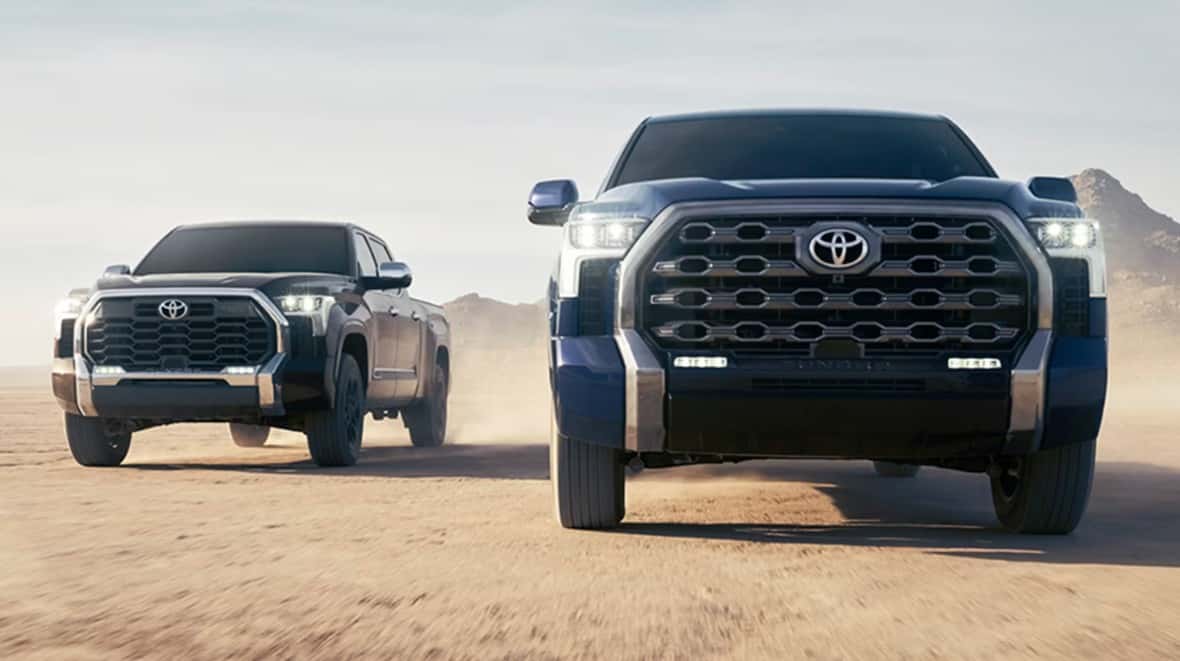
The 2026 Tundra’s i-FORCE MAX hybrid system delivers 437 horsepower and 583 lb-ft of instant torque — with electric-motor response that makes pulling heavy trailers smoother and more confident than any purely gas-powered alternative.
12,000 lbs Max Tow
SR5 Double Cab RWD with 6.5-ft bed — the highest towing rating in the entire 2026 Tundra lineup, enough for most boats, travel trailers, and loaded flatbeds Warsaw work demands.
583 lb-ft Torque
i-FORCE MAX hybrid — instant electric-motor torque with zero lag for confident pull-away, smooth highway merges, and hill climbing under full trailer weight.
1,850 lbs Payload
SR Double Cab RWD with 8.1-ft bed — the highest payload capacity in the 2026 lineup, with room for passengers, bed cargo, and trailer tongue weight combined.
Payload vs. Towing Capacity — Why Both Numbers Matter
Most buyers focus entirely on towing capacity and overlook a constraint that can limit their real-world setup before they ever hit the tow rating: payload. These two ratings work together, and exceeding either one is unsafe. Understanding the relationship between them is essential before you select a trim or configuration.
What Is Payload Capacity?
Payload is the maximum weight your Tundra can carry inside and on the bed — passengers, cargo, toolboxes, accessories, everything placed on or in the truck. The 2026 Tundra’s payload ranges from 1,420 to 1,850 pounds depending on configuration. Your specific truck’s payload sticker on the inside of the driver’s door jamb is the binding number — always check it, not the trim-level average.
Higher-trim trucks like the Platinum and Capstone have lower payload ratings because luxury equipment and hybrid components add vehicle weight. The SR with a long bed and rear-wheel drive carries the most payload at 1,850 pounds.
How Tongue Weight Reduces Your Payload Budget
Here’s what many buyers don’t realize: your trailer’s tongue weight counts against payload, not towing capacity. Tongue weight runs 10–15% of your trailer’s total weight. A 10,000-pound trailer carries approximately 1,000–1,500 pounds of tongue weight — which comes directly out of your payload budget before passengers and cargo are counted. The table below shows a real-world example using the SR at its maximum 1,850-pound payload:
| Weight Category | Amount (lbs) | Remaining Payload (lbs) |
|---|---|---|
| Starting Payload Capacity | — | 1,850 |
| Three Passengers | -600 | 1,250 |
| Bed Cargo and Tools | -200 | 1,050 |
| Available for Tongue Weight | — | 1,050 |
| Max Safe Trailer Weight (1,050 × 8) | — | ~8,400 lbs |
In this example, the practical tow limit is around 8,400 pounds — even if the towing spec reads higher. Always calculate both numbers before every major towing trip. Our team at Toyota of Warsaw can walk through these calculations with you in person before you finalize a configuration.
Key Factors That Affect Your Towing Capacity
The same Tundra trim can produce meaningfully different towing numbers depending on how it’s configured. Three variables have the largest impact on your final rating: bed length, drivetrain, and cab size.
Bed Length
The 6.5-foot standard bed is the sweet spot for towing. Paired with a Double Cab and RWD on the SR5, it unlocks the 12,000-pound maximum. The 5.5-foot short bed tops out at 11,450 pounds on the Limited i-FORCE MAX RWD and is popular for daily driving balance. The 8.1-foot long bed maximizes cargo length and payload — great for hauling lumber, fence posts, and farm equipment where length matters more than the highest tow number — but towing capacity ranges from 8,300 to 11,090 pounds depending on trim and drivetrain.
Rear-Wheel Drive vs. Four-Wheel Drive
RWD configurations can tow 100–800 more pounds than the equivalent 4WD setup because 4WD adds vehicle weight and drivetrain friction. For example, the SR5 CrewMax 5.5-foot bed in RWD tows 11,450 pounds; with 4WD it drops to 11,160 pounds. For Indiana winter roads, boat ramps, and farm field access, 4WD’s traction advantages often outweigh the capacity reduction. Buyers towing primarily on paved roads year-round may prefer RWD for maximum rating and slightly better fuel economy.
Double Cab vs. CrewMax
Double Cab models carry slightly higher towing and payload ratings than equivalent CrewMax trims due to lower vehicle weight. However, CrewMax’s longer wheelbase provides better towing stability and a noticeably smoother ride with a trailer attached — the extended wheelbase reduces pitch and sway on highway runs. Families and regular rear passengers favor CrewMax; contractors and maximum-capacity buyers often prefer Double Cab.
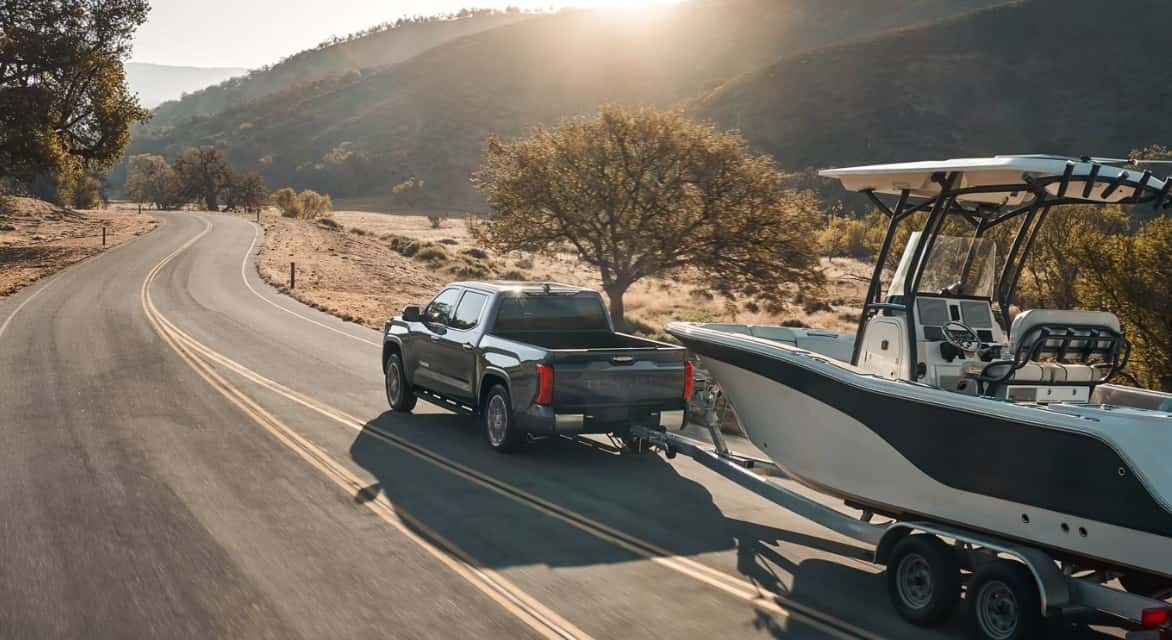
The 2026 Tundra’s fully boxed steel frame, Class-IV factory hitch, and Integrated Trailer Brake Controller make it one of the most capable and most tow-ready full-size trucks available — no packages required.
Advanced Towing Technology
Raw towing numbers only tell part of the story. What the Tundra does with a trailer attached — how it controls sway, manages braking, and provides visibility — separates it from trucks with similar specs on paper.
Integrated Trailer Brake Controller
Standard on most 2026 Tundra trims, the Integrated Trailer Brake Controller coordinates truck and trailer brakes from a dashboard-mounted control. It sends proportional braking force to your trailer’s electric brakes when you stop, eliminating the jackknife risk and the lurch that undersized trailer braking causes. A manual override lets you activate trailer brakes independently — useful for straightening a swaying trailer before the situation escalates.
Trailer Sway Control
Using onboard sensors that monitor speed, steering input, and lateral acceleration, Trailer Sway Control detects oscillation and responds automatically. It applies selective braking and reduces engine power to dampen sway before it builds into a dangerous situation. Crosswinds, passing semi-trucks, and sudden lane changes are the most common triggers. The system works in the background, activating only when needed — you may not notice it working until you see the trailer tracking straight.
TOW/HAUL Mode and Towing Visibility
TOW/HAUL mode adjusts transmission shift points and throttle mapping for towing loads. It holds lower gears longer during acceleration for smoother pull-away and provides stronger engine braking on descents, reducing brake wear on long downhill runs — especially valuable on the rolling terrain west of Warsaw toward US-30. The Trailer Backup Guide projects a visual path overlay for both truck and trailer in the backup camera display, making tight reversals manageable even for less experienced towers.
How the 2026 Tundra Compares to Competitor Trucks
The Tundra’s 12,000-pound maximum doesn’t top the full-size class on paper — but context matters when comparing specs. Here’s how it stacks up against the three main rivals, and where Toyota’s strengths become real ownership advantages.
| Truck | Maximum Towing | Peak Torque | Key Advantage |
|---|---|---|---|
| 2026 Toyota Tundra | 12,000 lbs | 583 lb-ft (hybrid) | Best reliability, resale value & standard equipment |
| Ford F-150 | 12,700 lbs | 570 lb-ft (PowerBoost) | Highest maximum towing number |
| Chevrolet Silverado 1500 | 13,300 lbs | 460 lb-ft (6.2L V8) | Available high-displacement V8 |
| Ram 1500 | 12,750 lbs | 410 lb-ft (5.7L HEMI) | Smoothest ride quality |
The F-150 leads the Tundra by 700 pounds at maximum, but only in specific configurations most buyers don’t end up purchasing. The Silverado’s 13,300-pound figure comes from its 6.2L V8, which requires premium fuel and carries lower long-term reliability scores. The Ram’s air suspension delivers an excellent ride, but its 5.7L HEMI produces 173 fewer lb-ft of torque than the i-FORCE MAX — a gap that matters when climbing grades at full trailer weight.
The Tundra comes with a Class-IV hitch from the factory; Ford charges extra for the same. Toyota Safety Sense is standard on every Tundra trim; Ram charges more for comparable technology on lower trims. And Toyota’s decade-long track record in long-term dependability rankings means your Tundra will be doing this same work well past 200,000 miles.
Towing Tips and Maintenance for Regular Towers
The 2026 Tundra is engineered to tow hard and last long — but regular towing puts extra stress on engine oil, brakes, and transmission fluid. A towing-specific maintenance schedule is the most important habit you can build to protect your investment and keep your Tundra performing at its rated capacity for years.
Best Practices Before Every Trip
Load trailers with 60% of cargo weight forward toward the hitch and 40% toward the rear — this creates proper tongue weight (10–15% of trailer total) and prevents sway before it starts. Use a weight-distribution hitch for any trailer over 5,000 pounds. Before departure, verify all lights on both truck and trailer, confirm coupler latch and safety chains, and engage TOW/HAUL mode. Take a short test drive in an empty area to confirm stability before hitting the highway.
| Maintenance Item | Standard Interval | Heavy Towing Interval | Why It Matters |
|---|---|---|---|
| Engine Oil Change | 10,000 miles | 5,000 miles | Prevents oil breakdown from heat and load stress |
| Brake Inspection | 20,000 miles | 10,000 miles | Maintains safe stopping power with added trailer weight |
| Brake Fluid Flush | 40,000 miles | 30,000 miles | Prevents brake fade on long downhill grades |
| Transmission Inspection | As needed | 60,000 miles | Prevents costly failures from heat and towing stress |
Our factory-trained technicians at Toyota of Warsaw specialize in maintaining trucks used for regular towing. Schedule service online any time — we’ll keep your Tundra on a towing-specific interval that protects the engine, brakes, and transmission for the long haul.
Ready to Find the Right Tundra for Your Towing Needs?
The 2026 Toyota Tundra delivers the power, engineering, and standard towing technology to handle nearly everything Indiana work and recreation demands. Whether you need the SR5’s 12,000-pound maximum, the TRD Pro’s combination of trail and tow, or the i-FORCE MAX hybrid’s torque-and-efficiency balance, the right configuration for your specific use is on our lot.
Visit Toyota of Warsaw at 448 W. 250 N., Warsaw, IN 46582. Our team will walk through towing configurations with you, run real payload calculations for your specific setup, and put you in the driver’s seat. Call (574) 267-4636 or explore financing options online.
Frequently Asked Questions
What is the maximum towing capacity of the 2026 Toyota Tundra?
The 2026 Toyota Tundra’s maximum towing capacity is 12,000 pounds, achieved with the SR5 trim configured as a Double Cab, rear-wheel drive, with a 6.5-foot bed and the enhanced i-FORCE gas engine. Other trims and configurations range from 8,300 to 11,450 pounds depending on engine, drivetrain, cab, and bed length. The SR5 represents the strongest value for buyers whose primary goal is the highest tow rating in the lineup. Visit Toyota of Warsaw to compare configurations in person.
Does the i-FORCE MAX hybrid tow more than the standard gas engine?
Not necessarily on paper — the i-FORCE MAX hybrid’s maximum tow rating (up to 11,450 lbs) is slightly lower than the gas SR5’s 12,000-pound peak. However, the hybrid’s 583 lb-ft of torque and instant electric-motor response make it the stronger choice for real-world towing confidence. It pulls more smoothly at capacity, climbs grades with less strain, and delivers significantly better fuel economy while towing. For buyers who prioritize confident everyday towing over the absolute maximum spec, the i-FORCE MAX is the better powertrain.
What is the payload capacity of the 2026 Toyota Tundra?
Payload capacity on the 2026 Tundra ranges from 1,420 to 1,850 pounds depending on trim, cab, bed length, and drivetrain. The SR Double Cab RWD with an 8.1-foot bed tops out at 1,850 pounds — the highest in the lineup. Higher-trim models like the Platinum and Capstone carry lower payload ratings because luxury equipment and hybrid components add vehicle weight. Always check the payload certification sticker on the inside of your driver’s door jamb — that figure is binding for your specific truck.
Does two-wheel drive or four-wheel drive affect the Tundra’s towing capacity?
Yes — rear-wheel drive configurations can tow 100 to 800 more pounds than the equivalent four-wheel drive setup, because 4WD adds vehicle weight and drivetrain friction. For example, the SR5 CrewMax 5.5-foot bed in RWD tows 11,450 pounds; with 4WD it drops to 11,160 pounds. For Indiana winter roads, boat ramps, and off-road access, 4WD’s traction advantage often outweighs the small capacity reduction. Buyers who tow primarily on paved roads year-round may prefer RWD for the higher rating and marginally better fuel economy.
What towing features come standard on the 2026 Toyota Tundra?
Every 2026 Tundra ships with a Class-IV hitch receiver, 7-pin wiring harness, Trailer Sway Control, TOW/HAUL transmission mode, and Toyota Safety Sense 2.5 at no extra charge. An Integrated Trailer Brake Controller is standard on most trims. Upper trims add Blind Spot Monitor with Trailer Detection, Panoramic View Monitor, and the Trailer Backup Guide with Straight Path Assist. These features are included in the base pricing — there is no separate tow package required to access the Tundra’s full rated capacity.
0 comment(s) so far on Toyota Tundra Towing Capacity