
Fifty miles per gallon, no charging cord, and a price that still starts in the mid-$20,000s. That combination is why the Toyota Corolla Hybrid 2026 keeps landing on shopping lists at Toyota of Warsaw — and why we put together this plain-English guide to trims, mileage, features, and what the car is actually like to own in northern Indiana.
The 2026 model carries over the pairing that made this compact sedan a commuter favorite: a 1.8-liter four-cylinder working with electric motors for 138 combined horsepower, routed through an electronically controlled continuously variable transmission. What changed this year is the equipment list. Blind Spot Monitor with Rear Cross-Traffic Alert is now standard on every trim, and the driver display grows to 7 inches on LE and SE and a full 12.3 inches on XLE. You can see one in person at our Toyota dealership in Indiana, or compare it against the rest of the Toyota hybrid lineup before you decide.
The short answer: The 2026 Corolla Hybrid LE and XLE with front-wheel drive are EPA-rated at 53 city / 46 highway / 50 combined MPG, electronic on-demand all-wheel drive is available on LE and SE, and every trim makes 138 combined horsepower. Want a specific trim and color? Use our Toyota vehicle finder service and we will track one down.
50 MPG Combined
EPA-estimated, LE and XLE with front-wheel drive
138 Combined HP
1.8L four-cylinder hybrid with eCVT
AWD Available
Electronic on-demand all-wheel drive on LE and SE
What Makes the 2026 Corolla Hybrid Worth a Look
The appeal here is not raw performance. It is the way a small hybrid system, a light chassis, and a genuinely useful equipment list add up to a car that costs very little to run and asks almost nothing of you in return.
A Hybrid System That Never Needs a Plug
The Corolla Hybrid is a full hybrid, not a plug-in. The 1.8-liter gas engine and the electric motors trade off automatically, and the battery recharges through regenerative braking and engine load — there is no cable, no wall box, and no charging stop to plan around. At low speeds and in parking lots the car often moves on electricity alone, which is exactly where a gas-only compact burns the most fuel. If you are still weighing formats, our explainer on hybrid, plug-in hybrid, and electric vehicles lays out the differences without the jargon.
Efficiency You Actually Feel at the Pump
With an 11.3-gallon tank and a 50-MPG combined rating, a front-drive LE or XLE can realistically cover 550 miles or more between fill-ups. For a Warsaw-to-Fort Wayne or Warsaw-to-South Bend commuter, that often means filling up twice a month instead of weekly. The gas-only Corolla is efficient in its own right at roughly 35 MPG combined, but the hybrid’s advantage widens the more stop-and-go driving you do.
Standard Safety and Technology Upgrades for 2026
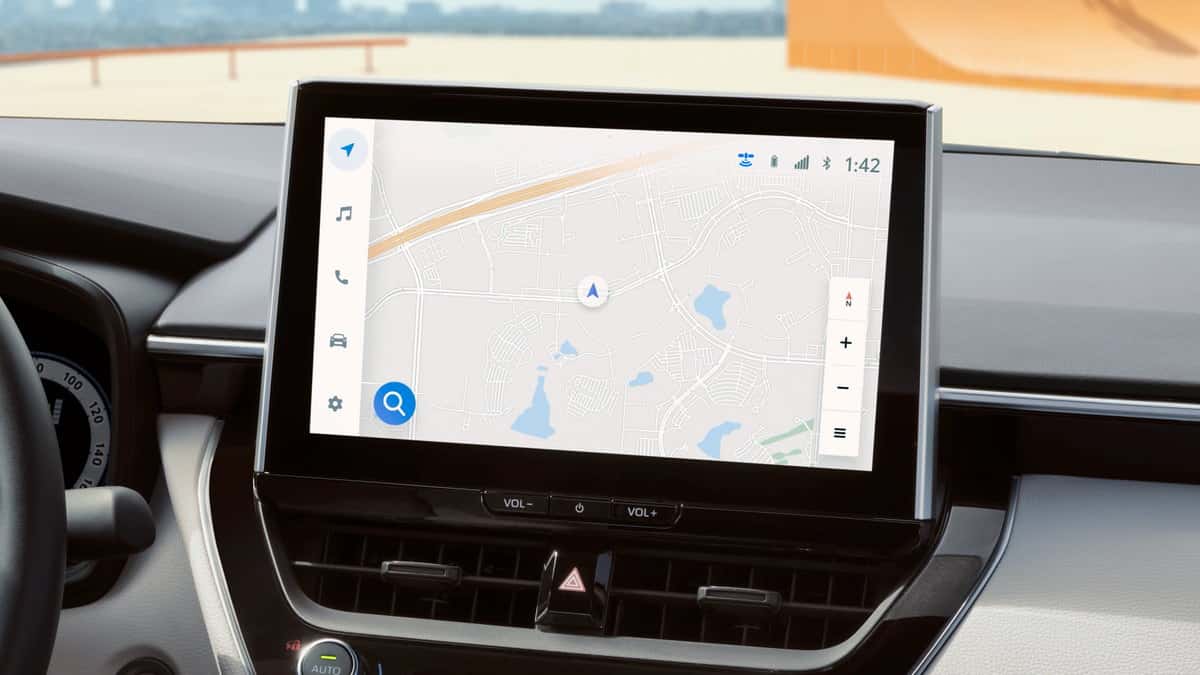
Every 2026 Corolla Hybrid includes Toyota Safety Sense 3.0, bundling the Pre-Collision System with Pedestrian Detection, Full-Speed Range Dynamic Radar Cruise Control, Lane Departure Alert with Steering Assist, Lane Tracing Assist, Road Sign Assist, and Automatic High Beams. New for this model year, Blind Spot Monitor with Rear Cross-Traffic Alert moves from an option to standard equipment across the lineup. An 8-inch touchscreen with wireless Apple CarPlay and Android Auto is standard, a 10.5-inch unit is available and standard on XLE, and a Wi-Fi hotspot is included on every trim.
| Feature Category | Specification | Why It Matters |
|---|---|---|
| Powertrain | 1.8L Four-Cylinder Hybrid with eCVT | Automatic gas-electric blending with no charging required |
| System Output | 138 Combined Horsepower / 105 lb-ft | Enough for confident merging while prioritizing efficiency |
| Drivetrain | Front-Wheel Drive Standard, AWD on LE and SE | Rear electric motor adds traction without a driveshaft |
| Safety | Toyota Safety Sense 3.0 plus standard Blind Spot Monitor | Driver-assist coverage on every trim, no package required |
| Technology | 8-in. Touchscreen Standard, 10.5-in. Available | Wireless Apple CarPlay and Android Auto across the lineup |
2026 Toyota Corolla Hybrid Trims, MPG, and Pricing
The lineup is refreshingly simple: three trims, front-wheel drive standard, and all-wheel drive available on the two lower trims. Fuel economy shifts with the trim you pick, and the differences are bigger than most shoppers expect.
LE, SE, and XLE: How the Trims Differ
The LE is the efficiency leader and the value play, with 16-inch wheels, cloth seating, the 7-inch driver display, and the full safety suite. The SE trades a few MPG for attitude — 18-inch alloy wheels, sport front seats, paddle shifters, and a firmer look inside and out. The XLE is the comfort pick, adding SofTex-trimmed seating, heated front seats, dual-zone automatic climate control, a 12.3-inch digital instrument cluster, and the 10.5-inch touchscreen as standard.
Fuel Economy by Trim and Drivetrain
Here is where the numbers land for 2026. Note that the SE’s larger wheels and sportier tuning cost it about three MPG combined against the LE, and that choosing all-wheel drive costs another two to three.
| Trim Level | Drivetrain | EPA City / Highway | Combined MPG |
|---|---|---|---|
| LE | FWD | 53 / 46 | 50 MPG |
| LE | AWD | 51 / 44 | 48 MPG |
| SE | FWD | 50 / 43 | 47 MPG |
| SE | AWD | 47 / 41 | 44 MPG |
| XLE | FWD | 53 / 46 | 50 MPG |
Starting MSRP runs from roughly $24,575 for the LE FWD to about $28,940 for the XLE, with all-wheel drive adding around $1,400 and a delivery, processing, and handling fee of $1,195 on top. Pricing and availability change, so check our current monthly specials for what is live this month.
Looking at a Used Corolla Hybrid Instead
The current-generation Corolla Hybrid dates to the 2023 model year, when Toyota added the AWD option and bumped combined output to 138 horsepower. Earlier 2020–2022 cars were front-drive only with 121 horsepower, and they still return excellent mileage. If your budget favors pre-owned, our Toyota Certified Pre-Owned inventory is the safest place to start, since CPO cars carry an extended limited warranty and a multi-point inspection.
What Actually Affects Your Real-World MPG
EPA ratings are a fair benchmark, not a promise. Most Corolla Hybrid owners land close to the sticker, and the ones who beat it usually understand these three variables.
Front-Wheel Drive Versus All-Wheel Drive
The available all-wheel-drive system uses a separate electric motor on the rear axle, engaging automatically from a standstill up to about 43 MPH when the front wheels start to slip. There is no driveshaft and no transfer case, so the weight penalty is modest — but it still trims roughly two MPG combined on the LE and three on the SE. For Kosciusko County winters, plenty of buyers decide that trade is worth it. If you rarely leave paved, plowed roads, front-wheel drive with good winter tires is the more efficient answer.
Trip Length, Temperature, and Driving Style
Hybrids shine in exactly the conditions that hurt conventional cars: short hops, traffic lights, and low-speed neighborhood driving. Cold weather is the main drag on winter mileage, because the engine runs more often to warm the cabin and the battery is less willing early in a drive. A few habits close most of the gap:
- Use ECO mode for daily driving and leave EV mode for parking lots and driveways
- Ease into the throttle so the car stays on electric power longer from a stop
- Coast early into stops so regenerative braking captures more energy
- Keep tire pressure at the door-jamb spec, especially once temperatures drop
- Skip long idling warm-ups — the hybrid system heats up faster while driving gently
Our guide to improving your car’s fuel efficiency goes deeper if you want to squeeze out every mile.
Load, Terrain, and Accessories
Extra passengers, a loaded trunk, and a roof-mounted carrier all cost fuel, and a roof box is the worst offender because of aerodynamic drag at highway speed. Northern Indiana’s flat terrain works in your favor here; sustained hill climbing is where hybrid advantages narrow. Running the air conditioning at full blast or the heater on high will also nudge consumption up, though the Corolla Hybrid’s electric-assist systems handle climate loads better than most.
Interior Space, Comfort, and Everyday Practicality
A hybrid is only a good commuter if it works as a car first. The Corolla Hybrid keeps the standard sedan’s packaging intact, with the battery tucked under the rear seat instead of eating into the trunk.
Cabin Dimensions and Seating
The Corolla Hybrid seats five and measures 182.3 inches long on a 106.3-inch wheelbase, which makes it easy to park downtown and simple to thread through a school pickup line. Rear-seat passengers get 34.8 inches of legroom and 37.1 inches of headroom — adequate for adults on a run to Fort Wayne, comfortable for kids and car seats every day.
Cargo Room and Storage
Trunk volume is 13.1 cubic feet, the same as the gas Corolla sedan, and the 60/40 split-folding rear seatback opens the space up for longer items. That is enough for a full grocery run, two large suitcases, or a set of golf clubs. Shoppers who need more room behind the second row often step up to the 2026 Corolla Cross specs and its taller hatchback body.
Materials, Noise, and Ride Quality
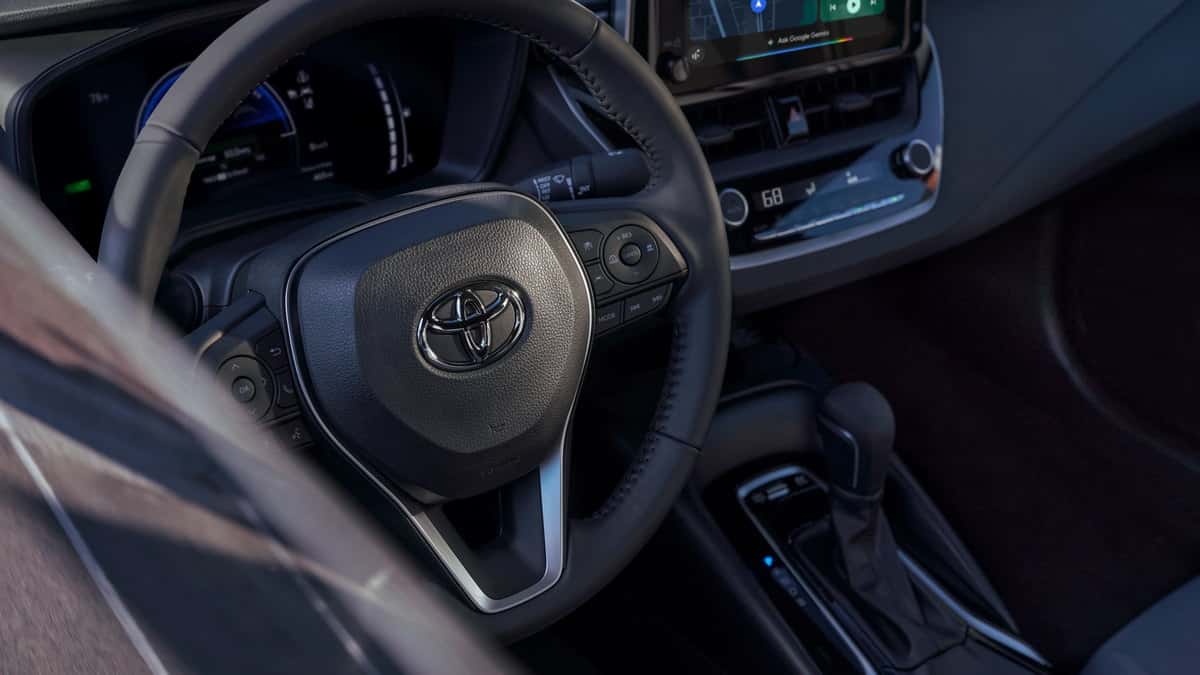
Upper trims add SofTex-trimmed seating, piano-black accents, and a wireless charging pad, and the XLE’s heated front seats earn their keep in February. The ride is tuned for comfort on LE and XLE and firmed up slightly on SE. Because the engine shuts off at stoplights and during light-load cruising, the cabin is noticeably quieter around town than a comparable gas compact.
Ownership Costs, Warranty, and Hybrid Battery Coverage
The question we hear most often is not about horsepower — it is whether a hybrid costs more to keep. For the Corolla Hybrid, the answer over a typical ownership period is no.
What Toyota Covers
Coverage starts with a 3-year/36,000-mile basic limited warranty and a 5-year/60,000-mile powertrain warranty. Hybrid-related components are covered for 8 years/100,000 miles, and the hybrid battery itself carries a 10-year/150,000-mile limited warranty, whichever comes first. That battery term is one of the longest in the segment and a big reason resale values hold up.
Routine Maintenance and ToyotaCare
Every new Corolla Hybrid includes ToyotaCare, which covers normal factory-scheduled maintenance for 2 years or 25,000 miles plus 2 years of unlimited-mileage roadside assistance. Day to day, maintenance looks like any other Corolla — oil changes, tire rotations, cabin filters — with one bonus: regenerative braking does much of the slowing, so brake pads and rotors commonly last far longer than they would on a gas-only car. When service time comes, you can schedule Toyota service in Warsaw online in about a minute.
Fuel Savings Over Time
Run the math on a 15,000-mile year at roughly $3.10 per gallon: a 50-MPG Corolla Hybrid burns about 300 gallons, while a 35-MPG gas Corolla burns about 429. That is a difference of roughly $400 a year, and it grows if your commute is heavy on city miles or fuel prices climb. Add the longer brake life and strong resale, and the hybrid premium tends to pay for itself well inside a typical loan term.
How the Corolla Hybrid Compares to Rival Compacts
The compact hybrid class has gotten crowded. Here is an honest look at where the Corolla Hybrid leads and where it does not.
| Vehicle | Best Combined MPG | Combined Horsepower | AWD Available |
|---|---|---|---|
| Toyota Corolla Hybrid | 50 MPG | 138 hp | Yes (LE and SE) |
| Hyundai Elantra Hybrid | 54 MPG | 139 hp | No |
| Kia Niro Hybrid | 53 MPG | 139 hp | No |
| Honda Civic Hybrid | 49 MPG | 200 hp | No |
The Elantra Hybrid and Niro edge the Corolla on paper MPG, and the Civic Hybrid is clearly quicker — but none of the three offer all-wheel drive, and the Civic Hybrid starts several thousand dollars higher. For Indiana buyers who want winter traction and 50 MPG in the same car, the Corolla Hybrid is the only one on this list that delivers both. If a larger sedan is on your radar, our Corolla vs. Camry comparison is a useful next read.
Who the 2026 Corolla Hybrid Is Right For
After walking hundreds of shoppers through this car, we have found it fits some drivers almost perfectly and others not at all. It is a strong match if you are:
- A daily commuter running 20–60 miles a day on a mix of city and highway roads
- A first-time new-car buyer who wants low payments and low running costs
- A hybrid-curious driver who does not want to manage charging or home wiring
- A two-car household adding an efficient second vehicle alongside a truck or SUV
- A parent buying a safe, easy-to-park first car with standard driver-assist tech
- A retiree or downsizer trading out of something larger and thirstier
- A rideshare or delivery driver where every MPG shows up directly in your income
If you regularly haul more than five people, tow anything, or need serious ground clearance, an SUV is the smarter buy — our article on choosing between a hybrid and a traditional SUV walks through that decision.
Explore More Toyota Hybrid Resources
Still comparing? Browse the full Toyota electrified vehicle lineup, see why shoppers rank us among the best car dealerships in northern Indiana, or start a no-obligation appraisal with our value your trade tool before you visit.
Ready to Drive the 2026 Corolla Hybrid?
Visit Toyota of Warsaw at 448 W 250 N, Warsaw, IN 46582, or call (574) 267-4636 to schedule a test drive. Our product specialists will help you compare LE, SE, and XLE, sort out whether all-wheel drive is worth it for your commute, and handle financing from start to finish.